
A nutrition label for AI-assisted content
Transparency over perfection. If you made it with AI, show your work.
AI collaboration is here. Transparency makes it legitimate.
Disclosure, not judgment. Like a nutrition label — informative, not prescriptive.
Regardless of AI percentage, a human signs off. That's the point.
How to use it
Start with intent
Tell your AI: "Let's use Provenance Label standards. Track our collaboration."
Work normally
Write, create, build. The AI tracks contribution throughout the session.
Generate the label
When done, ask: "Generate the Provenance Label." Review, approve, or adjust.
Add it to your work
Bottom of posts, READMEs, artist statements — wherever fits your medium.
Generate Your Label
Copy this prompt into your AI at the end of any collaborative session. It calculates percentages and formats the label — you review and approve.
Based on our collaboration in this session, generate a Provenance Label v1.2.

@provenance 1.2
author: [my name]
date: [today YYYY-MM-DD]
human: [X]
ai: [Y]
tools: [your name and version]
note: [one plain sentence describing how we worked together]

Requirements:
- human + ai must equal 100
- Calculate based on: who initiated content, who made decisions,
  who edited, what percentage of final output came from each
- Be honest, not flattering
- Output only the label block above, ready to copy-paste
Uses PLGen syntax — the open format both short and long outputs are generated from.
Output formats
The same label, two formats depending on where you're placing it:
PL v1.2 | Shelton Davis | 2026-02-17 | Human 65% · AI 35% · Claude Sonnet 4.6Use in: social posts, bylines, inline footers, Substack notes
─────────────────────────────────────
PROVENANCE LABEL v1.2
─────────────────────────────────────
Author:   Shelton Davis
Date:     2026-02-17
Human:    65%
AI:       35%
Tools:    Claude Sonnet 4.6
Note:     Concept and direction human.
          Draft and structure AI.
          Edited for voice.
─────────────────────────────────────
provenance-label.org/spec
Use in: blog posts, articles, documentation, research papers
Examples
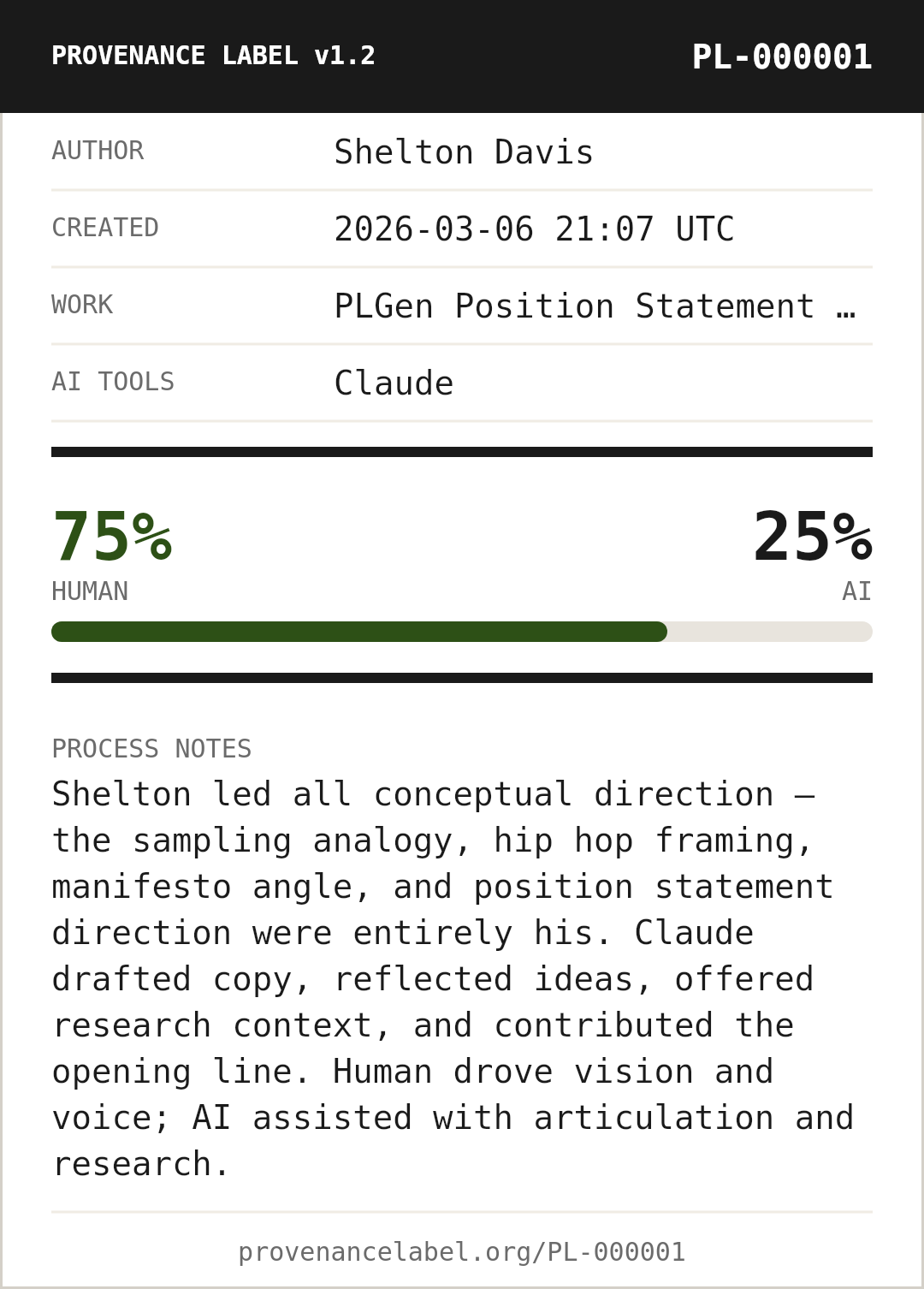
A real label
Blog Post — high AI contribution
Code Documentation — low AI contribution
Republished work — with shared-by field
FAQ
Is this anti-AI?
No. It assumes AI collaboration can be valuable when disclosed honestly.
How does the AI calculate percentages?
It tracks who initiated content, who made decisions, who edited, and what percentage of final output came from each contributor. It's an estimate — your approval is the final step.
Do the percentages have to be exact?
No. Aim for honest, not perfect.
What if my AI doesn't track this automatically?
Use the prompt above. Most modern AI tools can track collaboration if asked. For existing work, estimate retroactively.
Can I modify the label format?
Yes. It's open. If you change it significantly, version it (v1.1, v2.0). See the Spec for the full syntax rules.
Can Provenance Labels be faked?
Yes, like any self-disclosure system. It relies on creator integrity. Your reputation is on the line.
Does this protect against plagiarism?
No. This is disclosure, not verification. Think nutrition label — it tells you what's in it, not whether the ingredients are ethically sourced.
About
Created by Shelton Davis (Helper-ID, Empathy Lab) in February 2026. Born from a blog collaboration that needed better disclosure. Open standard. Free forever.
GitHub: github.com/provenance-label
License: CC BY 4.0 (standard) / MIT (code)
Contact: shelton@empathylab.io
What's next
The label format is done and free forever — that's the whole open standard, and it works today with any AI tool, no account needed. Registration, permanent public records, and badges are member features built on top of it. A Google Docs integration to make disclosure easier to capture in the moment is in early prototype; broader AI-tool support will follow demand, not the other way around.
This gets built in the open, one real user at a time. If you try it, tell me what's missing.